
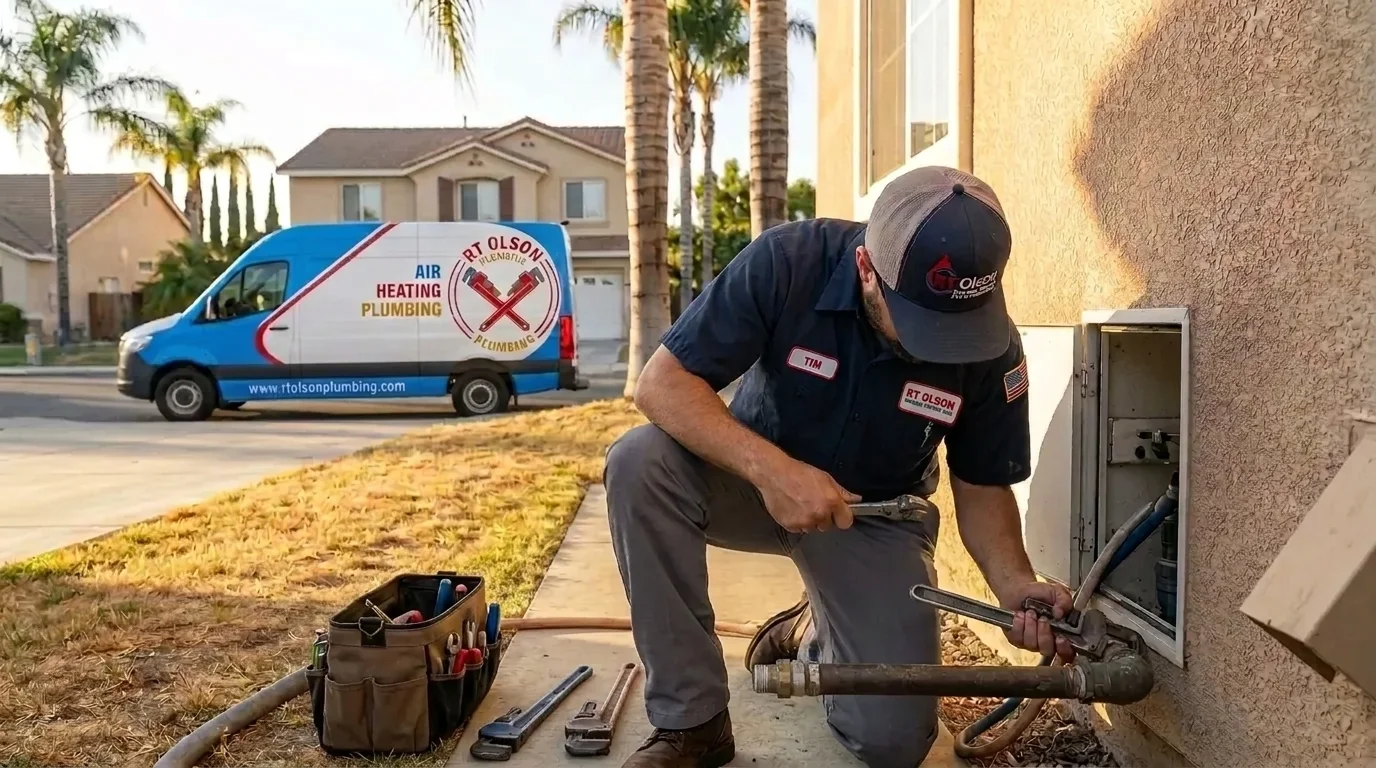
24/7 Emergency Plumbing in Ontario
Trusted emergency plumbing in Ontario, CA. Licensed and insured plumbing and HVAC pros, upfront pricing. Call (951) 344-5596.
Our technicians are dispatched from our Corona, CA headquarters and are typically on-site in Ontario within 60 minutes of your call.
Ontario’s inland location puts it squarely in the kind of heat-and-drought cycle that stresses pipes in ways coastal Southern California homeowners rarely encounter. When summer temperatures push past 100°F and then a cold snap rolls through the Inland Empire in January, the thermal expansion and contraction can split older supply lines, blow pressure-relief valves, and send water cascading through walls before you’ve had your morning coffee. RT Olson Plumbing, Heating and Air Conditioning dispatches around the clock from Corona, close enough to reach Ontario fast when a plumbing emergency can’t wait until morning.
Why Ontario Properties See Emergency Plumbing Issues
Ontario sits on the western edge of San Bernardino County, where the soil transitions from the looser alluvial fill near the Santa Ana River corridor to more compacted clay-heavy ground further inland. Clay soil shifts with moisture, it swells when it rains and shrinks back during dry spells. That movement puts lateral stress on buried drain lines and sewer laterals year after year. Cast-iron and Orangeburg sewer pipe installed in Ontario’s older residential tracts, many built during the postwar boom of the late 1940s through the 1960s, has had decades to corrode, crack, and collapse under that kind of ground movement.
On top of soil behavior, Ontario’s water supply carries a relatively high mineral content. Hard water accelerates scale buildup inside water heater tanks, narrows supply lines over time, and can cause pressure spikes that stress fittings and valves. A water heater that’s been rumbling and popping for months is often one thermal shock away from a failed pressure-relief valve or a cracked tank, both of which become emergencies fast.
Our Emergency Plumbing Process in Ontario
When you call, the first thing we do is ask two questions: where is the water going, and can you shut it off? If you can reach the main shutoff, usually near the meter at the street, stopping the flow immediately limits damage. If you can’t locate it or it won’t turn, we walk you through alternatives while a technician is already on the way.
On arrival, the technician assesses the source before touching anything else. A visible burst pipe is straightforward; a leak that’s already soaked into a wall cavity or subfloor requires locating the exact point of failure before opening drywall unnecessarily. We use leak detection equipment to pinpoint the problem, which matters in Ontario’s older stucco-and-wood-frame homes where water can travel a surprising distance from where it entered the structure. Once the source is confirmed and isolated, repair or replacement happens on the spot whenever parts allow, we stock common fittings, valves, and supply line components on every service vehicle.
Reaching Ontario from Corona
RT Olson’s base in Corona puts us on the 91 Freeway corridor, with direct access to the 15 and 60 interchange that feeds into Ontario. At off-peak hours the drive is straightforward. During peak commute windows on the 15 or through the Ontario Mills area, our dispatch routes technicians via surface streets, Milliken Avenue, Haven Avenue, and Euclid Avenue are all reliable north-south corridors that bypass freeway backups and keep response times predictable. We run 24/7, so middle-of-the-night calls don’t sit in a queue until morning.
Local Note
Ontario has a substantial stock of homes built on slab foundations during the 1950s and 1960s, and those slabs often contain copper supply lines that were embedded directly in the concrete. Decades of hard water, slight ground movement, and the alkaline soil chemistry common in this part of San Bernardino County have left many of those lines corroded from the outside in. A warm or damp spot on a tile floor, especially in a kitchen or hallway, is a classic early sign of a slab leak rather than a surface plumbing failure. Treating it as a simple drain clog or ignoring it until the water bill spikes can mean the difference between a targeted repair and a full slab penetration job. If you notice that warm patch underfoot, call before it escalates.
Plumbing emergencies in Ontario don’t follow a convenient schedule, and the damage they cause compounds by the hour. Whether it’s a burst supply line, a backed-up sewer lateral, a failed water heater, or a leak you can hear but can’t find, RT Olson is available around the clock to diagnose and repair it. Call (951) 344-5596 any time, day or night, and a technician will be on the way.
Serving Ontario from our Corona headquarters — ★ 4.9 · 615 Google reviews
“They did a very good job in fixing our garage water pipelines and in a timely manner.” — Rajat, October 2026Read our reviews on Google →
Emergency Plumbing in Ontario: Service Coverage
Frequently Asked Questions
How fast can you arrive for emergency plumbing in Ontario?
How quickly can RT Olson reach Ontario from your Corona location?
Ontario has a lot of older slab-foundation homes — does that change how you handle a leak?
Ontario's water is notoriously hard — can that cause a plumbing emergency?
What should I do first when a pipe bursts in my Ontario home?
Do you handle sewer line emergencies in Ontario, or just interior plumbing?
Will my homeowners insurance cover emergency plumbing in Ontario?
Emergency Plumbing response in Ontario
Most Ontario calls see a technician on-site within 60 minutes from our Corona headquarters.