TL;DR: A water softener removes calcium and magnesium (the minerals that make water “hard”) by passing it through a resin bed loaded with sodium or potassium ions, a process called ion exchange. The resin grabs the hard minerals and releases sodium or potassium in their place. Once the resin fills up with minerals, the system runs a regeneration cycle, flushing a saltwater brine through the tank to recharge the beads. Most homes in Riverside County, Corona included, get hard or very hard water from the city supply, so a softener here is doing real, constant work.
If you just turned on your faucet and noticed another chalky ring forming around the drain, or your shower door has that permanent cloudy film no amount of scrubbing removes, you’re living with hard water, and you’re probably wondering what a water softener actually does about it. It’s not filtering sediment out. It’s swapping one set of minerals for another through a chemical process called ion exchange, and understanding that swap is the key to knowing whether a softener is worth installing.
How does a water softener work?
A water softener uses ion exchange to trade hard minerals (calcium, magnesium, sometimes iron) for sodium or potassium ions as water passes through a resin tank. The result is water that no longer leaves scale behind or corrodes your plumbing and appliances.
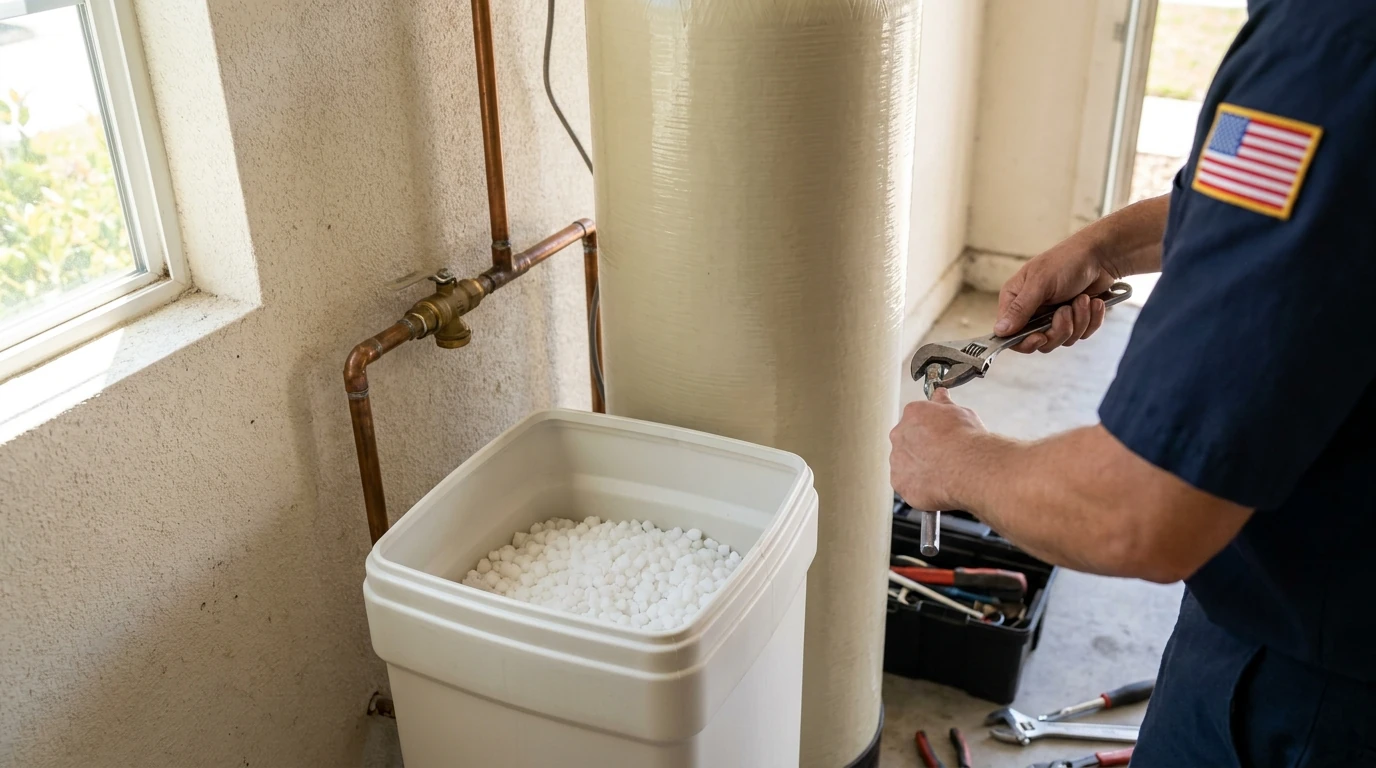
Inside the main tank sits a bed of small resin beads, each one coated with sodium or potassium ions. As hard water flows through, the beads attract and hold onto the calcium and magnesium ions, which carry a stronger positive charge, and release their own sodium or potassium ions into the water in exchange. The water leaving the tank is softened. Nothing is filtered out physically; it’s an electrical trade at the ion level.
This is a two-part system: softening (what just happened) and regeneration, which happens later once the resin bed is full of absorbed minerals and needs to be flushed and recharged.
What is hard water?
Hard water is water carrying an unusually high level of dissolved minerals, mainly calcium and magnesium, measured in grains per gallon (GPG) or milligrams per liter (mg/L). The usual scale: 0 to 60 mg/L is soft, 61 to 120 mg/L is moderately hard, 121 to 180 mg/L is hard, and anything above 180 mg/L is very hard. The harder the water, the more corrosive it is on plumbing and appliances, and the worse it tends to taste.
Most tap water starts as groundwater or surface water and picks up minerals from the rock and soil it travels through before a municipal system treats and delivers it. Here in Riverside County, most homes get hard or very hard water from the city. The U.S. Geological Survey has a plain-language explainer on how water picks up hardness.
You’ll usually notice hard water before you test it. Limescale rings on faucets and showerheads, soap that won’t lather, a white crust on the dishwasher’s heating element, and clothes that come out of the wash feeling stiff are all early signs. The slower damage, scale building up inside your water heater’s tank, mineral deposits narrowing pipe diameter, and reduced efficiency in your dishwasher and washing machine, takes longer to show up but costs more to fix.
How do you test your water for hardness?
You can confirm hard water in minutes with an inexpensive test strip from a hardware store, or get a more precise reading with a TDS (Total Dissolved Solids) meter. Either tells you enough to decide if softening makes sense.
Test strips give a fast read on hardness level by color change. A TDS meter measures everything in the water that conducts electricity, which includes hardness minerals along with other dissolved solids, so it’s a useful gauge but not hardness-specific. For a lab-accurate number, a water testing lab will give you exact GPG or mg/L figures, though for most homeowners this level of precision isn’t necessary: if a test strip shows hard or very hard, the fix is the same regardless of the exact number.
What happens during regeneration?
Regeneration is the cleaning cycle a water softener runs automatically to flush out the absorbed hard minerals and recharge the resin beads with fresh sodium or potassium ions. Without it, the softener eventually stops working because the resin has nothing left to trade.
The cycle runs in stages. First, a backwash flush loosens and removes the collected minerals from the resin bed. Then water draws brine, a concentrated sodium or potassium salt solution, from the smaller brine tank into the main resin tank, recoating the beads with fresh ions. A final rinse clears out the leftover brine before the system returns to service.
How often does a softener need to regenerate?
Older, timer-based softeners regenerate on a fixed schedule regardless of actual water use, which often wastes salt and water or leaves the resin under-recharged. Modern metered systems track actual gallons used and regenerate only when the resin bed is genuinely depleted, which is the more efficient, more common approach in new installs today.
Can a water softener actually save you money?
Yes, if you have hard water, a softener typically pays for itself over time by extending the life of your water heater, fixtures, and major appliances, and by reducing how much soap and detergent you use. Hard water scale is one of the more common accelerants of early water heater failure, something covered in more detail in our water heater lifespan guide.
Scale buildup inside a tank water heater reduces heating efficiency and can shorten its service life. The same mineral deposits narrow pipe diameter over years and work against washing machines, dishwashers, and faucet cartridges. On the smaller end, hard water keeps soap and shampoo from lathering properly, which means using more of both, a cost that adds up over a year without most people noticing.
Pros of water softening:
- Extends the service life of your water heater and fixtures
- Reduces mineral buildup inside pipes and appliances
- Softer on clothes and skin
- Soap and detergents work as intended, so you use less
- Low electrical cost to operate (roughly $10/year)
Cons of water softening:
- Adds a small, non-significant amount of sodium to treated water
- Uses additional water during regeneration cycles
- Ongoing cost of salt or potassium pellets
Is a water softener the same as a water filter?
No. A water softener addresses hardness minerals only; it is not designed to remove lead, bacteria, or other contaminants. For that, you need a separate whole-house filtration or reverse osmosis system, which handles contaminants a softener was never built to touch.
Many homeowners pair the two: a whole-house softener to protect plumbing and appliances, plus a point-of-use reverse osmosis system under the kitchen sink for drinking and cooking water. If chlorine taste or smell is your main concern rather than hardness, our guide on removing chlorine from tap water covers that separately.
Will a softener strip out minerals your body needs?
No. A softener targets only calcium and magnesium, the minerals responsible for hardness, and does not remove other beneficial minerals from your water. It adds trace sodium or potassium in their place, not filters your water down to nothing.
If anyone in the household follows a low-sodium diet, a potassium-chloride brine is the straightforward swap, and a reverse osmosis system at the kitchen tap will reduce trace sodium or potassium further for drinking water specifically.
How long until you notice the difference after installation?
Cold water runs soft immediately after a new softener is installed and online; there’s no waiting period. Hot water may take slightly longer to show the change if your tank has existing hard water sitting in it, since that water needs to cycle through and be replaced with newly softened supply.
What does it cost to run a water softener day to day?
A residential softener typically costs around $10 a year in electricity and $50 to $100 a year in salt or potassium pellets, a modest ongoing cost against the appliance and plumbing lifespan it protects. That operating cost is one of the lowest of any plumbing fixture in the house, which is part of why softening tends to pay off in homes with genuinely hard water.
What size softener does your home need?
Softener sizing depends on household size, water hardness level, and daily water usage, not a one-size-fits-all number. Undersizing means frequent regeneration cycles and premature resin wear; oversizing wastes salt and tank space. Getting this number right is worth a proper water test and a conversation about your household’s actual usage rather than guessing from a chart. Our guide on how to size a water softener walks through the math, and what a water softener costs covers the budget side.
If you’re ready to stop scrubbing limescale off fixtures and want your water heater and appliances to last as long as they’re built to, request a water softener quote from RT Olson Plumbing, Heating and Air Conditioning and we’ll size the system to your home’s actual water conditions rather than a generic estimate.
About RT Olson Plumbing, Heating and Air Conditioning
RT Olson Plumbing, Heating and Air Conditioning has served Corona, CA and the surrounding Inland Empire since 2014, holding California contractor license #997337 (verify any contractor’s license at cslb.ca.gov). The company offers 24/7 service and holds a 4.9-star Google rating across more than 600 reviews. This guide first ran on RT Olson’s previous website and was updated for Corona homeowners in October 2026.
Need help now? Call RT Olson Plumbing, Heating and Air Conditioning at (951) 344-5596.