
TL;DR: To size a water softener, test your water’s hardness in grains per gallon (gpg), add 4 gpg for every 1 ppm of iron in the water, then multiply hardness by your household’s daily water use in gallons. Multiply that daily number by 7 to get the weekly grain capacity you need, then round up to the next standard tank size (24,000, 32,000, 48,000, or 64,000 grains). Going up a size, not down, saves money on salt and keeps the resin bed healthy.
If you’re standing in front of three water softener boxes with no idea whether your home needs the 32,000-grain model or the 48,000-grain model, the math behind that decision is more approachable than it looks. Get it wrong on the small side and you’ll wear out the resin bed fast, lose water pressure, and run more maintenance calls than you should. Get it wrong on the large side and you’ll pay more upfront for a tank that barely works hard enough to regenerate properly. The five numbers below get you to the right size without guessing.
How do I find my water’s hardness level?
Water hardness is the concentration of calcium and magnesium in your water, and you need an actual number before you can size anything. It’s measured in grains per gallon (gpg), milligrams per liter (mg/L), or parts per million (ppm). If your reading comes back in mg/L or ppm, divide by 17.2 to convert it to gpg.
Don’t estimate this number. A softener sized off a guess is a softener that either fails early or wastes salt for the next decade. You have three reliable ways to get a real reading:
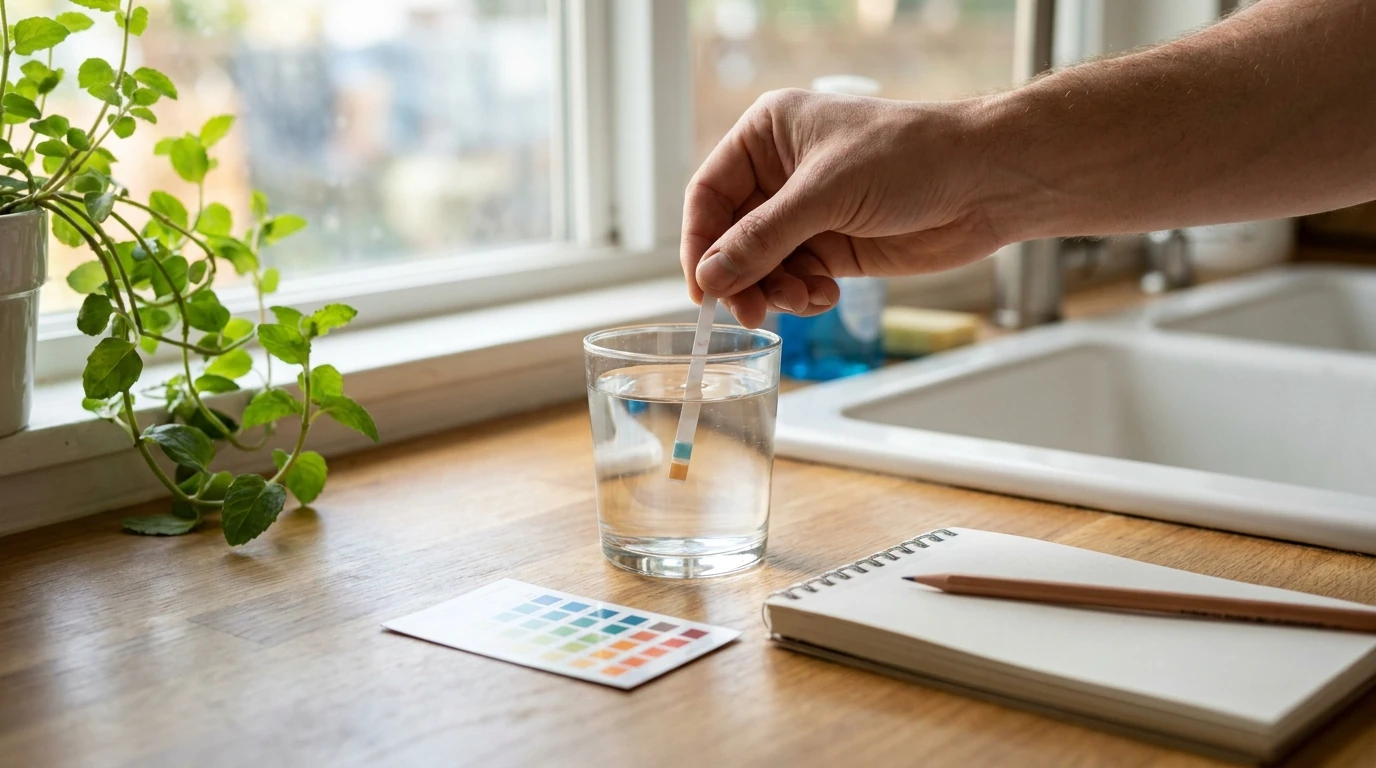
- Test it yourself. Inexpensive at-home hardness test kits give a workable reading in minutes.
- Request a water quality report. If you’re on a municipal supply, your water provider can send you a current report, or you can find one online. This option isn’t available if your home runs on a private well.
- Send a sample to an independent lab. A neutral lab has no incentive to oversell equipment and gives the most precise number.
What if my water has iron in it?
If you’re on a well, check for iron before you finalize your hardness number. For every 1 ppm of iron in your water, add 4 gpg to your total hardness figure. If manganese shows up on your water report, the same 4-gpg-per-1-ppm adjustment applies.
How much water does my household actually use per day?
Your daily water consumption, multiplied by hardness, is what tells a softener how many grains it needs to remove every single day. Unlike hardness, you can work with a reasonable estimate here rather than a lab-precise number.
The most accurate approach is pulling your last water bill and dividing the billing period’s total by the number of days it covers. If you don’t have a bill handy, the US Geological Survey estimates the average person uses 80 to 100 gallons of water per day. Lean toward 80 if your household takes short showers; lean toward 100 if water use is less of a daily consideration. Multiply that per-person number by the number of people in the home to get your household’s daily gallons.
How do I calculate the softener size I actually need?
Multiply your water’s hardness (in gpg) by your household’s daily water use (in gallons) to get your daily softening requirement, then multiply that by 7 for the weekly grain capacity your softener needs to handle.
Here’s why the weekly number matters: a softener’s resin bed can only strip out a limited number of hardness grains before it needs to regenerate, the process where the system flushes accumulated minerals and resets the resin. Ideally, a softener is sized so it only needs to regenerate about once a week, since more frequent regeneration wastes water (a cycle can use up to 50 gallons) and wears the control valve faster, while less frequent regeneration risks running out of capacity mid-week.
So the formula in full:
Hardness (gpg) x Daily water use (gal) = Daily softening requirement Daily softening requirement x 7 = Weekly grain capacity needed
What size tank matches that number?
Standard residential softeners come in a handful of sizes: 24,000, 32,000, 48,000, and 64,000 grains (sometimes labeled by cubic feet of resin, where a 24,000-grain unit is roughly a “.75 cubic foot” system). Once you have your weekly grain capacity requirement, round UP to the next standard size, not down.
Here’s the part most buyers get backward: a tank that exactly matches your weekly number will technically work, but it burns through salt fast and inefficiently, because full regenerations use more salt per gallon of capacity than partial regenerations do. A slightly larger tank lets the system do a partial regeneration more often, which saves salt, puts less wear on the control valve, and reduces how much wastewater goes down your drain or into your septic system. The salt efficiency rating, listed on the unit as grains removed per pound of salt, is worth comparing between models for exactly this reason.
What else affects the right size besides grain capacity?
Flow rate, measured in gallons per minute (gpm), determines whether your softener can keep up with hard water during peak demand, like a shower running while the dishwasher and washing machine both start a cycle. Larger households typically need a system rated around 15 gpm; smaller households can often get by around 7 gpm. If flow rate is too low for your peak demand, hard water bypasses the resin bed and you’ll notice pressure drop and scale returning even with an adequately sized tank.
This guide covers residential sizing. Commercial water softeners use different flow and capacity math entirely; if you’re sizing for a commercial property, that’s a conversation for a licensed technician, not a DIY calculation.
Worked example: sizing for a family of three
Say a household of three tests their water at 12 gpg through an independent lab, and estimates usage at 80 gallons per person per day (240 gallons total for the household).
- Daily softening requirement: 12 gpg x 240 gal = 2,880 grains/day
- Weekly grain capacity needed: 2,880 x 7 = 20,160 grains/week
A 24,000-grain system would technically clear that number, but rounding up to a 32,000-grain system gives this household more resin volume, fewer full regenerations, and real savings on salt over the life of the unit.
Do I need a softener, a filter, or both?
A water softener and a whole-house filter solve different problems, and many homes benefit from running both. A softener’s only job is pulling calcium and magnesium out of the water to stop scale buildup; a filter’s job is removing broader contaminants like chlorine, sediment, and taste and odor issues. Multi-stage systems that combine softening and filtration in one cabinet exist, and they’re sized by the same hardness and usage math above, with filter media (a 4.5-inch by 20-inch filter is customary for these combination systems) sized separately; how long it lasts depends on how much sediment is in your water, and a larger filter needs servicing less often. If you’re also dealing with taste or contaminant concerns beyond hardness, a reverse osmosis system at the kitchen tap is worth pairing with a whole-house softener rather than trying to solve both problems with one device. For a closer look at the mechanics, see how a water softener actually works.
When should you have a pro size it instead of doing the math yourself?
If your hardness reading, iron levels, or household usage sit anywhere close to the line between two standard tank sizes, a technician who sizes softeners regularly can run the numbers against your home’s actual fixture count and peak flow demand before you buy. RT Olson Plumbing, Heating and Air Conditioning can test your water, account for iron and flow rate together, and walk you through actual unit pricing once the sizing is settled; see current water softener and filtration pricing for a sense of what different system sizes run in this market.
Getting the math right on paper is step one. Matching that number to a real tank, your home’s plumbing layout, and your household’s actual peak demand is where a second set of eyes pays off. Call RT Olson Plumbing, Heating and Air Conditioning at (951) 344-5596 to have your water tested and the right size confirmed before you buy.
About RT Olson Plumbing, Heating and Air Conditioning
RT Olson Plumbing, Heating and Air Conditioning has served Corona, CA and the surrounding Inland Empire since 2014, holding California contractor license #997337 (verify any contractor’s license at cslb.ca.gov). The company offers 24/7 service and holds a 4.9-star Google rating across more than 600 reviews. This guide first ran on RT Olson’s previous website and was updated for Corona homeowners in October 2026.