
Leak Detection in Ontario
Trusted leak detection in Ontario, CA. Licensed and insured plumbing and HVAC pros, upfront pricing. Call (951) 344-5596.
Our technicians are dispatched from our Corona, CA headquarters and are typically on-site in Ontario within 60 minutes of your call.
Ontario’s position in the eastern Inland Empire means long stretches of hot, dry summers followed by occasional heavy rain events, a cycle that stresses underground supply lines and slab foundations in ways that don’t always announce themselves right away. A slow pinhole leak beneath a concrete slab can quietly saturate the subgrade for weeks before you notice warm flooring, a musty odor, or a water bill that suddenly climbs without explanation. When that happens, RT Olson Plumbing, Heating and Air Conditioning is available around the clock to locate the source precisely, before the damage spreads.
Why Ontario Properties See Leak Detection Issues
Ontario sits on the western edge of the San Bernardino Valley, where expansive clay soils shift with seasonal moisture changes. That movement puts stress on buried copper and galvanized supply lines, particularly in homes built during the post-war residential boom of the 1950s through the 1970s. Galvanized pipe from that era corrodes from the inside out, and the first sign of trouble is often a pinhole leak hidden inside a wall cavity or beneath a slab, not a visible drip at a fixture.
The region also has hard water. High mineral content accelerates scale buildup inside copper lines, thinning pipe walls over time and creating weak spots that fail under normal operating pressure. If your water meter is spinning when every fixture in the house is off, or if one section of flooring feels noticeably warmer than the rest, those are classic signs of a slab leak that warrants electronic detection rather than exploratory demolition.
Ontario’s rapid commercial and residential development over the past two decades has also produced a mix of irrigation systems, shared utility easements, and HOA-governed common areas where underground leaks can cross property lines, complicating both the diagnosis and the repair authorization process.
Our Leak Detection Process in Ontario
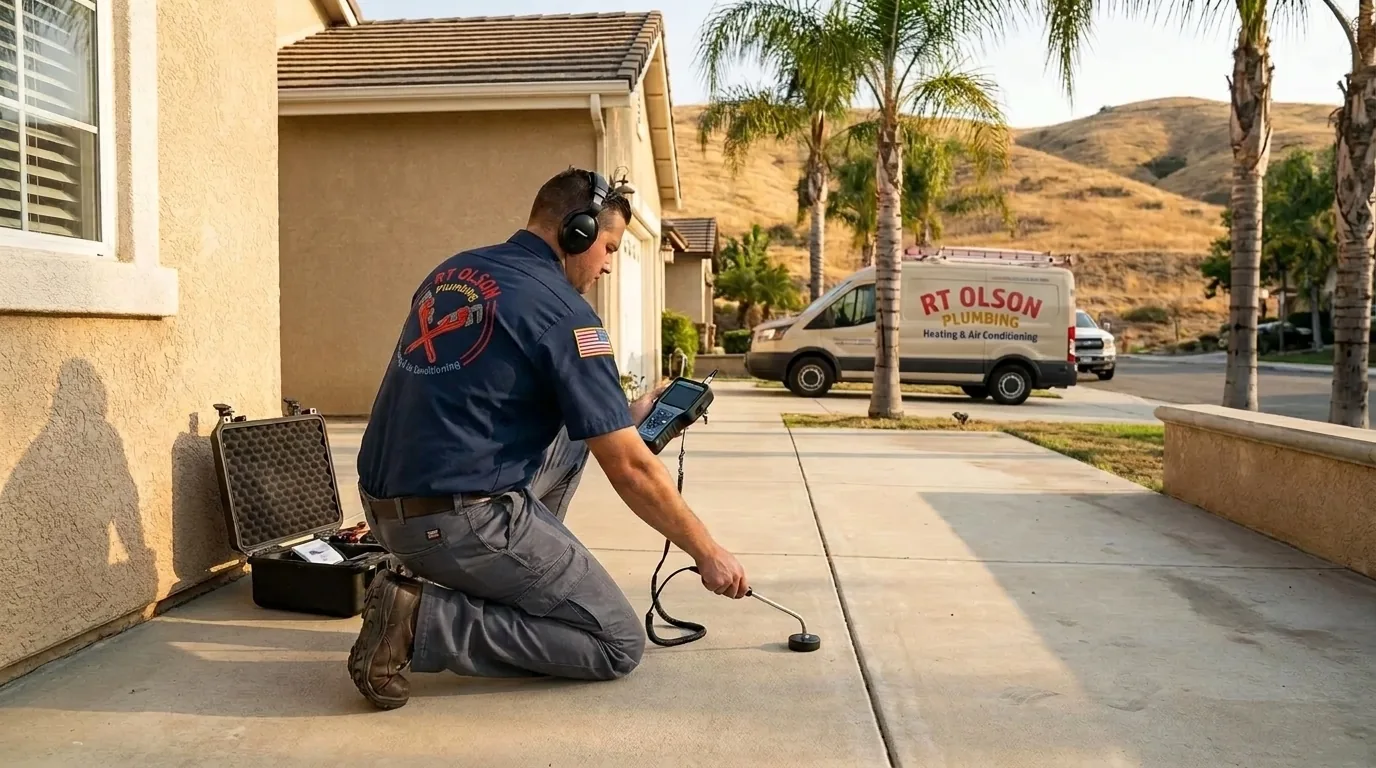
Electronic leak detection removes the guesswork that used to mean tearing up tile or opening walls across a wide search area. The process begins with a pressure test on the supply system to confirm a leak exists and to isolate which branch is affected. From there, acoustic listening equipment amplifies the sound signature of water escaping under pressure, a frequency that travels through concrete, soil, and pipe material differently depending on depth and ground composition.
In Ontario’s clay-heavy soils, acoustic readings require calibration because clay dampens sound transmission more than sandy or loamy ground. Thermal imaging adds a second data layer: a slab leak warms the concrete above it, and an infrared camera maps that heat gradient precisely, narrowing the target area before any concrete is touched. Combining acoustic and thermal methods means the crew marks a specific location, not a three-foot search zone, before any saw or jackhammer is involved.
For underground irrigation or service line leaks in yards or common areas, ground microphones and tracer gas detection allow us to pinpoint breaks without trenching the full line length.
Reaching Ontario from Corona
RT Olson operates out of Corona, and Ontario is a routine service area reached via the 91 freeway to the 15 north, or through surface routes on Hamner Avenue and Milliken Avenue depending on time of day. Because we dispatch around the clock, we can reach Ontario properties at hours when freeway traffic is light and response is fast, something that matters when a slab leak is actively running and every hour of delay means more saturated subgrade material.
Local Note
Ontario has a significant stock of tract homes built in the 1960s and early 1970s that used copper supply lines with soldered joints. In the Inland Empire’s hard-water environment, those joints are a known failure point, the solder corrodes at a different rate than the surrounding copper, and leaks tend to develop at the joint itself rather than mid-pipe. When we’re detecting leaks in homes from that era, we pay particular attention to joint locations near manifolds and under slab transitions, because a single failed joint often signals that neighboring joints are under similar stress.
Ontario Insurance & HOA Coordination
Many Ontario neighborhoods, particularly newer master-planned communities on the city’s northern and eastern edges, are governed by HOAs that have specific requirements about how and when underground or slab work can be performed. Some require written notification before any concrete cutting, and others designate approved contractors for work in common utility corridors.
We document the detection process thoroughly: pressure test readings, acoustic data logs, thermal images, and a marked diagram of the leak location. That documentation supports homeowner insurance claims and satisfies HOA disclosure requirements without requiring a second site visit. If your carrier or association needs a written scope before authorizing repair, we can provide it.
When a hidden leak in Ontario has driven your water bill up unexpectedly, contact RT Olson Plumbing, Heating and Air Conditioning at (951) 344-5596. We’ll locate the source with precision equipment, document everything you need for insurance or HOA approval, and give you a clear path to repair, without unnecessary demolition.
Serving Ontario from our Corona headquarters — ★ 4.9 · 615 Google reviews
“They did a very good job in fixing our garage water pipelines and in a timely manner.” — Rajat, October 2026Read our reviews on Google →
Leak Detection in Ontario: Service Coverage
Frequently Asked Questions
How fast can you arrive for leak detection in Ontario?
Can you detect a slab leak under a concrete foundation in Ontario's clay soil without breaking concrete first?
My water bill in Ontario has spiked but I can't find any visible leak — what's the most likely cause?
Does Ontario's HOA-heavy development pattern affect how leak detection and repair work gets authorized?
How do you locate an underground irrigation or service line leak in an Ontario yard without trenching the whole line?
RT Olson is based in Corona — how quickly can you reach an Ontario address for a leak detection call?
Will my homeowners insurance cover leak detection in Ontario?
Leak Detection response in Ontario
Most Ontario calls see a technician on-site within 60 minutes from our Corona headquarters.