
Leak Detection in Riverside
Trusted leak detection in Riverside, CA. Licensed and insured plumbing and HVAC pros, upfront pricing. Call (951) 344-5596.
Our technicians are dispatched from our Corona, CA headquarters and are typically on-site in Riverside within 60 minutes of your call.
Riverside’s combination of aging clay-soil neighborhoods, hard Inland Empire water, and summer heat that regularly pushes past 100°F creates conditions where hidden leaks don’t stay hidden for long, they just move somewhere you can’t see. A slow pinhole in a copper supply line or a hairline crack in an underground main can quietly saturate soil for weeks before it shows up as a damp spot on drywall or an unexplained spike on your Southern California Gas or Western Municipal Water District bill. RT Olson Plumbing, Heating and Air Conditioning offers 24/7 leak detection in Riverside, using electronic and acoustic equipment to find the source without tearing out walls or digging up your yard on a guess.
Why Riverside Properties See More Hidden Leaks
Riverside’s housing stock spans a wide range of eras and materials, and each era comes with its own leak profile. Homes built in the postwar boom through the 1970s, common throughout older residential corridors in the city, were often plumbed with galvanized steel pipe that has long since reached the end of its useful life. Galvanized corrodes from the inside out, narrowing first and then failing at joints and elbows where mineral deposits concentrate. Riverside’s water is notoriously hard, and that mineral load accelerates the process.
Beyond the pipes themselves, the expansive clay soils that underlie much of the Inland Empire shift seasonally. A dry summer followed by heavy winter rain causes the ground to heave and settle, and underground supply lines or irrigation laterals that cross those movement zones develop stress fractures over time. That kind of underground leak can run for months, the water simply migrates down through the soil rather than surfacing, while your meter keeps spinning.
Our Leak Detection Process in Riverside
When a call comes in, the first step is a meter test: we isolate the home and watch the meter for movement with all fixtures off. That confirms there’s an active leak and gives us a rough flow rate before any equipment comes out of the truck. From there, the approach depends on what the meter and a visual inspection suggest.
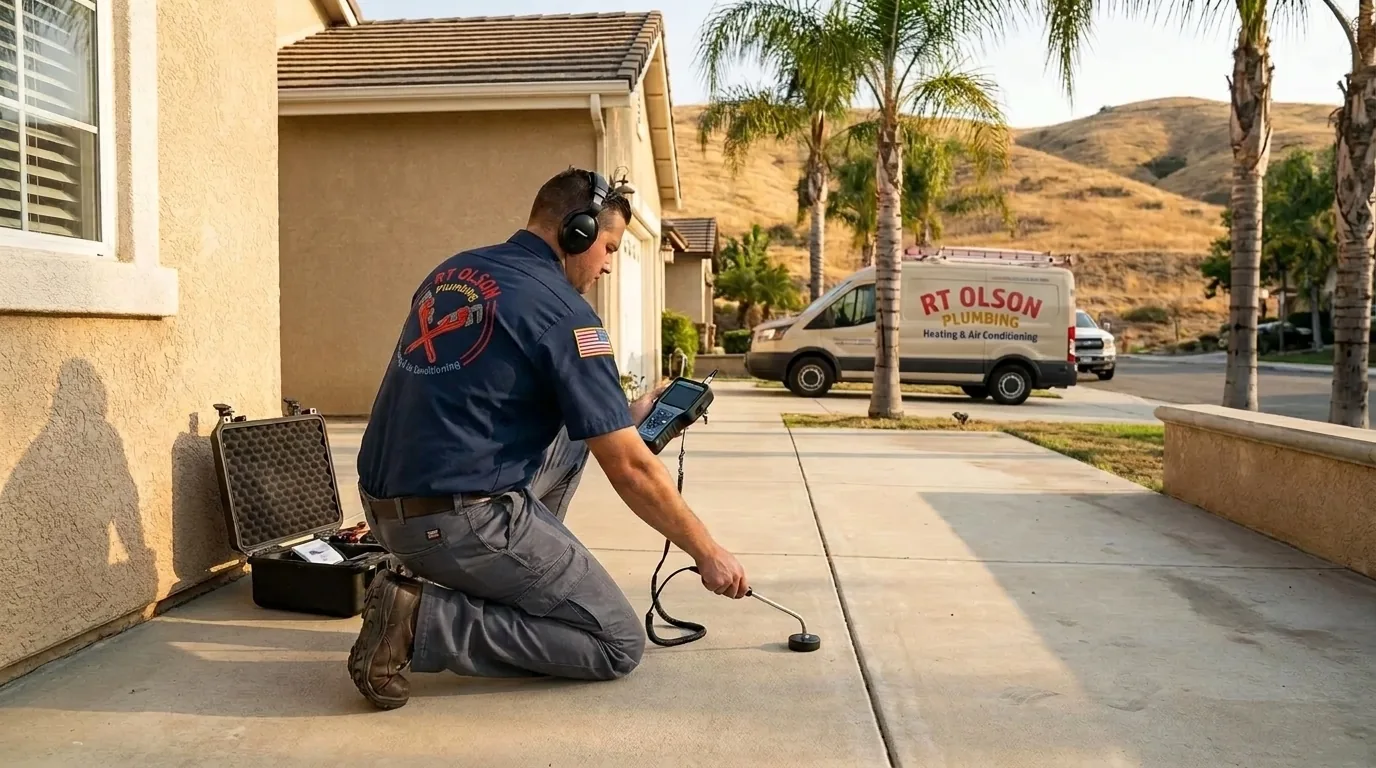
For suspected underground or slab leaks, we use acoustic listening equipment that picks up the specific frequency of water escaping under pressure, different from ambient noise, different from normal pipe flow. Correlating sensors let us triangulate the leak location along a run of pipe so the excavation or access point, if one is needed, is precise rather than exploratory. For leaks behind walls or above ceilings, thermal imaging cameras detect temperature differentials caused by evaporating moisture, often pinpointing a wet cavity before it’s visible to the eye.
We document everything, meter readings, camera captures, acoustic data, so you have a clear record for your insurer or, if you’re in an HOA community, for the association’s maintenance coordinator.
Reaching Riverside from Corona
Our shop is in Corona, which puts us on the west side of Riverside County with straightforward access to Riverside via the 91 freeway or Highway 71 depending on traffic. We run 24/7, so whether a leak surfaces at noon or 3 a.m., a technician can be dispatched immediately. The 91 corridor connects quickly to central Riverside, and from there it’s a short run to the residential neighborhoods where most of our leak detection calls originate. If you’re calling from the eastern or northern reaches of the city, let the dispatcher know, they’ll route accordingly.
Local Note: Hard Water and Copper Fittings in Riverside
One pattern that comes up repeatedly in Riverside homes plumbed with copper in the 1980s and 1990s: the fittings fail before the straight pipe does. Riverside’s water hardness causes scale to build at solder joints and compression fittings, and the resulting turbulence erodes the copper from the inside, a process called erosion corrosion. The leak often starts as a weep at an elbow or tee inside a wall cavity, not at an exposed fixture where you’d notice it immediately. If your water bill has crept up gradually over several months rather than spiking overnight, that slow-weep pattern at a concealed fitting is worth ruling out before assuming the meter is wrong.
Call (951) 344-5596 any time, day or night, and describe what you’re seeing. If your bill is climbing, your meter is moving with everything off, or you’ve noticed warm flooring or a damp smell you can’t source, that’s enough to warrant a detection visit. We’ll find the leak, show you exactly where it is, and give you a straight answer on what fixing it involves before any work begins.
Serving Riverside from our Corona headquarters — ★ 4.9 · 615 Google reviews
“These guys were on time and they did quality work.” — Bob, October 2026Read our reviews on Google →
Leak Detection in Riverside: Service Coverage
Frequently Asked Questions
How fast can you arrive for leak detection in Riverside?
My Western Municipal Water District bill jumped significantly this month — could that indicate a hidden leak in my Riverside home?
Are older Riverside homes with galvanized or copper plumbing more prone to hidden leaks?
How does Riverside's expansive clay soil affect underground water line leaks?
What does the electronic leak detection process actually involve, and how long does a visit typically take?
Do you respond to leak detection calls in Riverside overnight or on weekends?
Will my homeowners insurance cover leak detection in Riverside?
Watch: Leak Detection in Riverside
Leak Detection response in Riverside
Most Riverside calls see a technician on-site within 60 minutes from our Corona headquarters.