
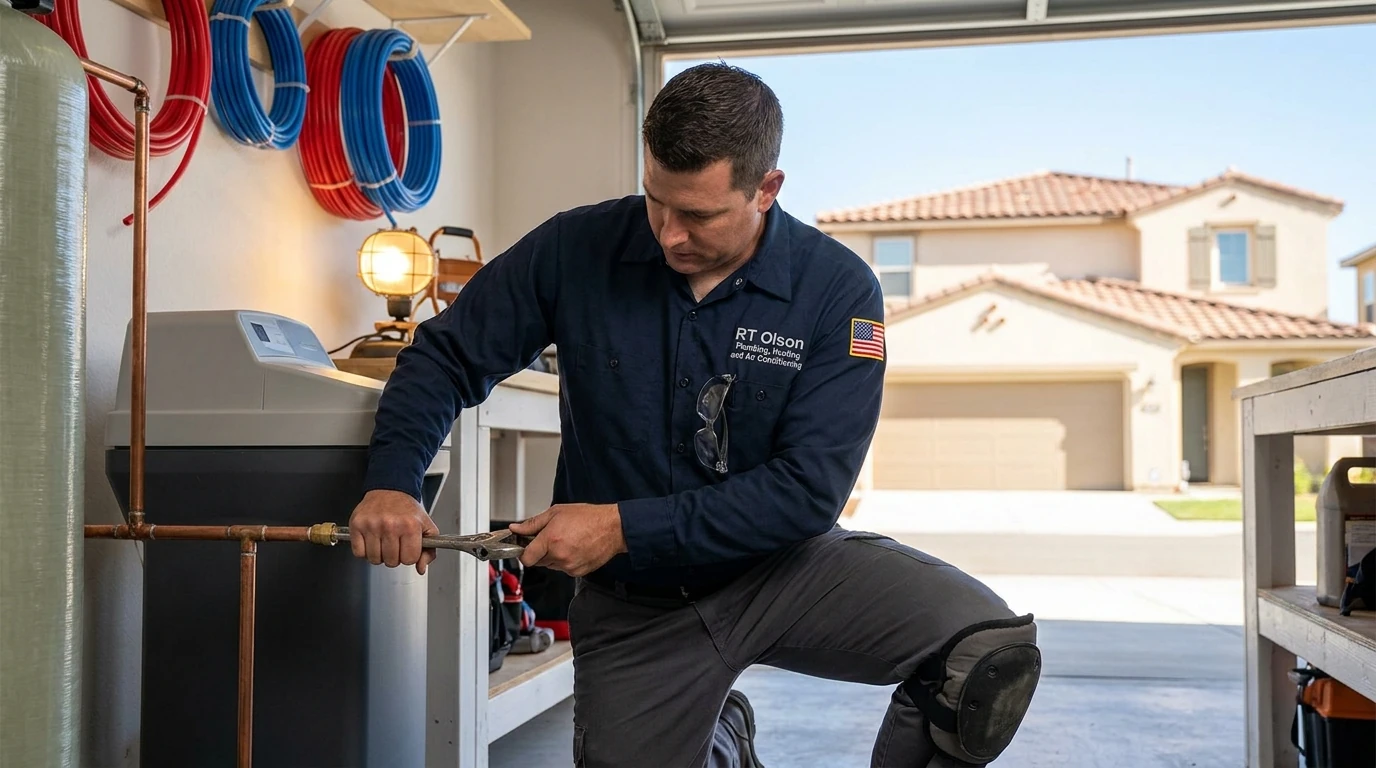
TL;DR: Water treatment in Corona, CA usually means a salt-based water softener paired with a carbon filter or reverse osmosis system, since Corona’s groundwater is hard enough to scale pipes and appliances but softening alone won’t improve chlorine taste or remove dissolved solids. The right combination depends on a water test, your household size, and whether your area restricts self-regenerating softeners. Installed whole-house systems typically run $1,500 to $4,000, with under-sink RO adding $400 to $1,200.
If every glass out of the dishwasher has a cloudy film, the showerhead in your Eagle Glen or Dos Lagos bathroom is crusted white, and the water heater needs flushing twice a year just to keep up, that’s Corona’s hard water at work, not a defective appliance. Corona’s public water supply draws heavily on groundwater from the Santa Ana River basin, and it carries enough dissolved calcium and magnesium to rank as very hard. The fix is a treatment system sized to your actual water, not whatever unit happened to be on sale. Here’s how to tell whether you need a softener, a filter, a reverse osmosis system, or some combination, and what it costs to get it installed correctly.
Why is Corona’s water so hard?
Corona’s municipal water is hard because it’s pumped largely from groundwater in the Santa Ana River basin, where it picks up calcium and magnesium as it moves through mineral-rich soil and rock. Local hardness commonly falls in the 15 to 20+ grains per gallon range, a level the U.S. Geological Survey classifies as very hard.
That mineral load isn’t a health concern on its own, but it’s rough on plumbing and appliances. Scale builds up inside water heater tanks, cutting efficiency and shortening the unit’s working life (see our guide on water heater lifespan). It spots shower glass, dulls fixtures faster, and means more soap or detergent for the same lather, something homeowners around Eagle Glen, Dos Lagos, and the older streets near Green River with original galvanized supply lines notice especially fast.
What’s the difference between a water softener and a water filter?
A water softener swaps hardness minerals for sodium or potassium ions through a resin bed, while a water filter removes chlorine taste, sediment, or specific contaminants using carbon or membrane media. Most hard-water homes benefit from both, not just one.
The softener’s resin bed regenerates with a brine solution on a set schedule or on demand based on actual water use (our how a water softener works guide covers the mechanics). A carbon filter, by contrast, addresses the chlorine taste and odor municipal water treatment leaves behind, which is a separate problem from hardness (see how to remove chlorine from tap water). Corona’s water is treated to meet EPA Safe Drinking Water Act standards before it reaches your tap, so none of this is about safety; it’s about taste, scale, and appliance life.
Which water treatment system is right for my home?
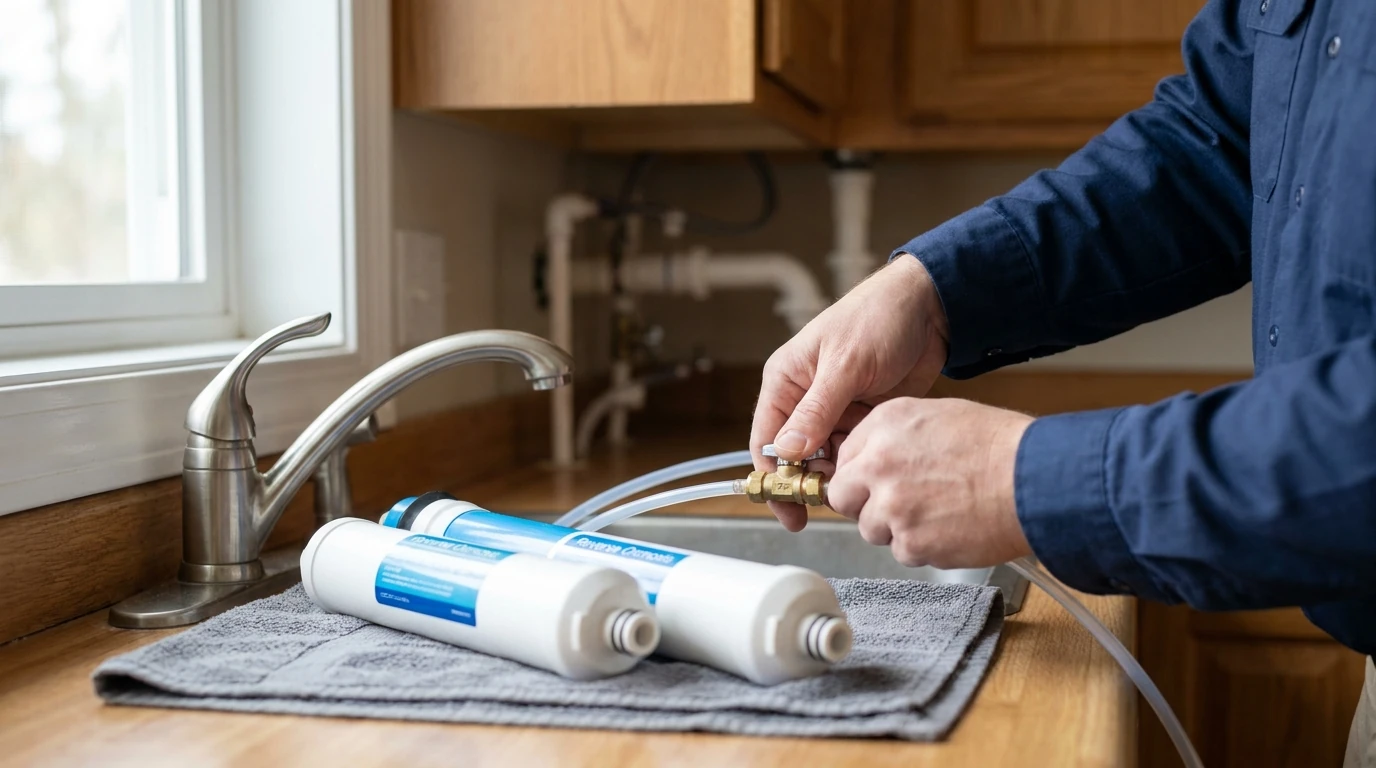
Most Corona homes end up with a whole-house water softener to protect pipes and appliances, plus either a whole-house carbon filter for chlorine taste or a dedicated reverse osmosis system at the kitchen sink for drinking water, chosen based on an actual water test and how the household uses water.
- Standard household, 2-4 people: a 32,000 to 48,000 grain softener sized to your flow rate and hardness level. The full math is in our water softener sizing guide.
- Strong chlorine taste or odor from the tap: a whole-house or under-sink carbon filter solves this without touching hardness minerals.
- Want the cleanest possible water for drinking and cooking: a reverse osmosis system at the kitchen sink removes dissolved solids a softener and carbon filter leave behind.
- Considering a self-regenerating softener: check with Corona’s water department first. Several cities in the Santa Ana River watershed restrict or require permits for self-regenerating units because the brine they discharge affects water reclaimed for irrigation and groundwater recharge. A demand-initiated regeneration valve or a salt-free conditioner may be the compliant option.
What does professional water treatment installation cost in Corona?
A professionally installed whole-house water softener in Corona typically runs $1,500 to $4,000 depending on grain capacity and brand, a whole-house carbon filtration system adds roughly $1,000 to $2,500, and an under-sink reverse osmosis system runs $400 to $1,200 installed.
Price swings come from resin and tank size, whether the valve head is digital and demand-initiated, and whether existing plumbing needs rerouting to fit a bypass loop. Our full water softener cost breakdown covers equipment tiers and ongoing salt costs in more detail. A written quote should spell out grain capacity, resin type, warranty length on tank and resin separately, and what maintenance, like salt refills or filter swaps, falls on you versus the installer.
How do I get started?
Start with a water test, either a simple at-home hardness kit or a professional test that also checks chlorine, iron, and total dissolved solids, then match the equipment to what the test shows rather than guessing.
A technician can test your water on the same visit as an inspection, check your water heater and existing plumbing for compatibility, and put grain capacity, equipment brand, and total installed cost in writing before any work starts. Request a water treatment consultation or call RT Olson Plumbing, Heating and Air Conditioning at (951) 344-5596 to get a system sized for your actual home.
Hard water is one of those problems that’s easy to live with and expensive to ignore. RT Olson Plumbing, Heating and Air Conditioning has installed and serviced water softeners, filtration, and reverse osmosis systems for Corona and Inland Empire homeowners since 2014, and sizing the system to the water you actually have, not a generic recommendation, is what keeps it working for the next fifteen years.
About RT Olson Plumbing, Heating and Air Conditioning
RT Olson Plumbing, Heating and Air Conditioning is a licensed plumbing, heating, and air conditioning contractor (license #997337) based in Corona, CA, serving the Inland Empire and North Orange County since 2014. The company offers 24/7 emergency service and holds a 4.9-star average across more than 600 Google reviews. This guide was prepared with Bob Olson and the company’s technical team, who handle water softener and filtration installs, water heaters, and drain, sewer, and HVAC work across Riverside and San Bernardino counties.