If a pipe has just burst in your home, do these four things right now: shut off the main water supply, cut power to affected rooms, open a cold tap to drain pressure, and call a licensed plumber. Everything else, the cleanup, the insurance call, the drywall repair, comes after those four steps. The next ten minutes will determine how much water soaks into your framing, insulation, and flooring, so move fast but move in order.
Step-by-Step: The First 10 Minutes
Think of this as a countdown. Every minute of active flow adds gallons to the damage.
1. Find and close the main shutoff valve (minutes 1–2)
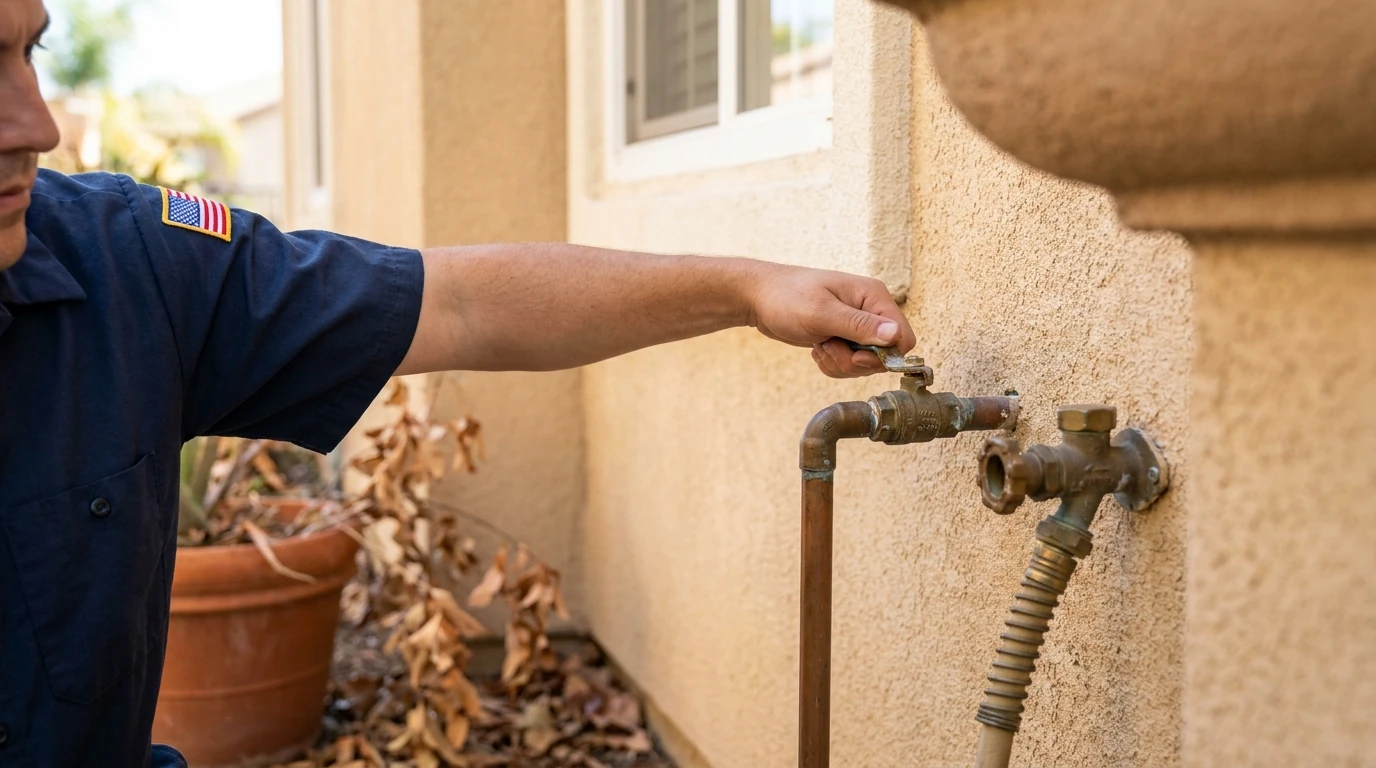
Your home’s shutoff is usually where the main water pipe enters the house, often near a hose bib at the front or side of the home. If it has a round wheel, turn it clockwise until it stops. If it has a lever handle (a ball valve), rotate it 90 degrees so it sits perpendicular to the pipe. Water to the inside of the house should stop within seconds. The full walkthrough, including when the valve at the street meter comes into play, is in the next section.
If you have never located this valve, do it today, before anything goes wrong. Tape a note to your water heater with the location.
2. Switch off electricity to wet areas (minute 2–3)
Water and live circuits are a serious hazard. Go to your breaker panel and cut power to any room where water is actively flowing or pooling. If the panel itself is in a wet area, do not touch it, call 911 and stay out of the space.
3. Open a cold faucet on the lowest floor (minute 3–4)
With the main valve closed, there is still pressurized water sitting in the pipes. Opening a faucet, a bathtub tap or a utility sink works well, lets that remaining water drain down and out rather than continuing to seep through the break.
4. Document everything before you touch it (minutes 4–6)
Walk the affected area with your phone and shoot video. Pan slowly across the ceiling stain, the wet floor, the visible pipe. This footage is your insurance claim. Adjusters work from evidence, and a 90-second video taken before cleanup is worth more than photographs taken after you’ve moved furniture.
5. Move what you can, fast (minutes 6–10)
Rugs, upholstered furniture, electronics, and wood furniture absorb water quickly and can be total losses if left sitting. Lift rugs off wet floors entirely, a wet rug traps moisture against hardwood or subfloor and accelerates mold growth. Stack furniture on aluminum foil squares or plastic bags if you cannot move it out of the room.
How To Shut Off Your Home’s Water
Knowing how to shut off the water to your home is the single most useful thing to learn before an emergency. Here is how it works:
- Find where the main water pipe enters your home. This is usually where there is a hose bib at the front or side of the house.
- Turn the valve. On a lever-style valve, turn the handle so it sits at a 90 degree angle to the pipe going into the house. On a round wheel, turn it clockwise until it stops. That turns off all water to the inside of the house and stops additional water damage from a leak indoors.
If the leak is between the meter and the house, this will not stop it. The house valve only shuts off water to the house, not the yard. If the line from the meter to the house is leaking, or a sprinkler valve or the main sprinkler feed is broken, the water has to be shut off at the meter.
Be careful with the meter valve. Many water districts do not allow homeowners to touch the shutoff at the meter and may fine you if you do. It usually requires a special key, and in some areas plumbers are not allowed to operate it either. Call your water utility, tell them you have a leak, and ask them to shut off the main.
Not sure where the leak is? Before you call the water company, confirm you have a leak and whether it is inside the house or out in the yard. A simple water meter test tells you, and our guide on how to find a water leak walks through it. Once you are sure the leak is between the meter and your home, call the utility to have the main shut off for the repair. If you can, coordinate the timing with your plumber, because the plumber often needs the water on to pinpoint the leak.
What NOT to Do
In a burst-pipe emergency, a few instincts will make things worse:
- Don’t use a shop vac or household vacuum on standing water if the power is still on in that room. Cut the breaker first.
- Don’t assume the wet area is the only wet area. Water follows framing cavities and can travel six feet horizontally inside a wall before it shows up as a stain. Press your palm along the drywall above and around the visible damage, if it feels cool and slightly soft, water is behind it.
- Don’t use a hair dryer or space heater to dry things out yourself. Surface drying without addressing moisture inside the wall cavity creates the exact conditions mold needs: warmth and trapped humidity.
- Don’t pour bleach on wet drywall. It does not prevent mold growth inside a water-saturated wall cavity, and it can mask odors that would otherwise alert you to a hidden moisture problem.
- Don’t wait to call your insurance company. Most homeowner policies have a reporting window, and delayed notification can complicate your claim.
How to Recognize Hidden Water Damage
Not every burst pipe announces itself with a waterfall. A pinhole failure in a supply line inside a wall may run for hours before you notice anything. Here is what to look for:
- Ceiling bubbling or sagging: Paint that blisters or drywall that looks pregnant with water means there is standing water above it. Do not stand under it.
- Warm or soft spots on the floor: In a slab-foundation home, a warm patch on a tile floor with no other explanation can indicate a hot-water line break beneath the concrete. That is a slab leak, and it requires specialized detection equipment.
- A sudden spike in your water meter: If you suspect a hidden leak, turn off every fixture in the house and watch the meter dial for two minutes. If it moves, water is going somewhere it should not.
- Musty smell without visible mold: Mold can colonize drywall paper within 24 to 48 hours of saturation. A smell without a stain usually means the damage is inside the wall.
When to Call a Plumber (and What to Tell Them)
Call a licensed plumber as soon as the immediate hazards are controlled, meaning the water is off, the power is safe, and you have documented the scene. Do not wait until morning if water is still moving or if you cannot locate the shutoff.
When you call, tell them:
- Where in the house the break appears to be (kitchen, bathroom, exterior wall, under slab)
- Whether you have shut off the main supply
- Whether the water was hot or cold (this helps identify which line failed)
- How long the leak was active before you noticed it
That information lets a plumber arrive with the right materials and equipment rather than diagnosing blind. Burst-pipe repair in a finished wall is different work than a failed hose bib on an exterior wall, the repair scope, the access method, and the drying timeline all differ.
The Recovery Process After the Repair
Fixing the pipe is the beginning, not the end. Here is what follows:
- Moisture mapping. A plumber or water damage professional uses a moisture meter to find the full boundary of saturation, not just what looks wet, but what reads wet. In stucco construction, moisture can wick into the lath layer and stay there long after the surface feels dry.
- Drying. Industrial air movers and dehumidifiers pull moisture out of structural materials. This typically takes several days, not hours, and the equipment needs to stay in place until readings confirm drywall and framing are back to acceptable moisture levels.
- Mold assessment. If water was present for more than 24–48 hours before drying began, a mold assessment is worth the cost before you close the wall back up.
- Reconstruction. Once materials are confirmed dry, drywall, insulation, flooring, and paint can be restored. This is usually coordinated with your insurance adjuster.
A Final Word
A burst pipe is a stressful event, but the damage is largely controllable if you act in the right order. Shut off the water, protect yourself from electrical hazards, document before you clean, and get a plumber on the phone. If you are in the Corona area and need burst-pipe repair or emergency plumbing help, RT Olson Plumbing, Heating and Air Conditioning offers 24/7 emergency plumbing and is reachable at (951) 344-5596. Even if you are still in the middle of cleanup, a quick call can help you understand what comes next.